Dubai is not just a city; it is the "Fruit Bowl" of the Middle East. It re-exports 40% of what it imports to Saudi Arabia, Oman, and Kuwait. While the Philippines and Ecuador are big players, India has a massive logistical advantage: Proximity.
A container from Ecuador takes 35 days to reach Dubai. A container from Nhava Sheva (Mumbai) takes only 4-5 days. This freshness factor is your biggest competitive edge.
However, bananas are highly perishable. One mistake in temperature control or harvesting maturity, and your cargo will arrive as "Black Pulp" instead of "Yellow Gold."
This guide covers the A-to-Z of exporting G9 Cavendish Bananas to Dubai.
1. Market Intelligence: What Does Dubai Want?
Dubai buyers are extremely specific about quality. They do not want "local market" bananas.
The Variety: Cavendish G9 (Grand Naine). This is the global standard. It has a thick peel (good for transport), long shelf life, and sweet taste.
The Look: They want Green Bananas.
Rule #1: You never export yellow bananas. They must be 100% Green, hard, and unripe.
Ripening: The ripening happens in Dubai at the buyer's ripening chambers using Ethylene gas.
Demand Cycle: High demand during Ramadan and summer months.
2. The Product: Export Specifications
You must instruct your farmers/suppliers to strictly follow these specs. Any deviation leads to rejection.
| Parameter | Export Standard (Dubai) |
| Variety | G9 Cavendish |
| Length | Min 18 cm (measured from pulp to tip, excluding the neck) |
| Caliber (Thickness) | 39 mm - 48 mm |
| Maturity | 80% - 85% (Do not harvest at 100% maturity!) |
| Hands per Box | 4, 5, or 6 Hands (clusters) per box |
| Appearance | Clean skin, no latex stains, no black spots, no thrips (insects) |
3. Packaging: The "13.5 Kg" Rule
Packaging is where the profit is made or lost. Dubai has a standard box size.
Box Weight: 13.5 Kg Net Weight (approx 14.2 Kg Gross).
Note: If you send 12 Kg or 15 Kg boxes, they might not sell. The wholesale market trades in "13.5 Kg units."
Box Type: 5-Ply Corrugated Telescopic Box (Top & Bottom separate).
Strength: Must withstand the weight of 20 boxes stacked on top of it in a humid container.
Inside the Box:
Foam Sheets: Between hands to prevent friction/bruising.
Vacuum Bag: The bananas are packed inside a plastic bag, and air is sucked out (Vacuum Packing) to slow down ripening.
4. Sourcing Hubs: Where to Buy in India?
Jalgaon & Solapur (Maharashtra): The largest hub. Close to Nhava Sheva Port (Mumbai). Best for logistics speed.
Theni (Tamil Nadu): Excellent quality G9. Closer to Tuticorin/Chennai Port.
Anantapur (Andhra Pradesh): Growing hub for export-quality bananas.
5. Logistics: The "Cold Chain" (Crucial)
You cannot ship bananas in a normal truck. The "Cold Chain" must start at the farm gate.
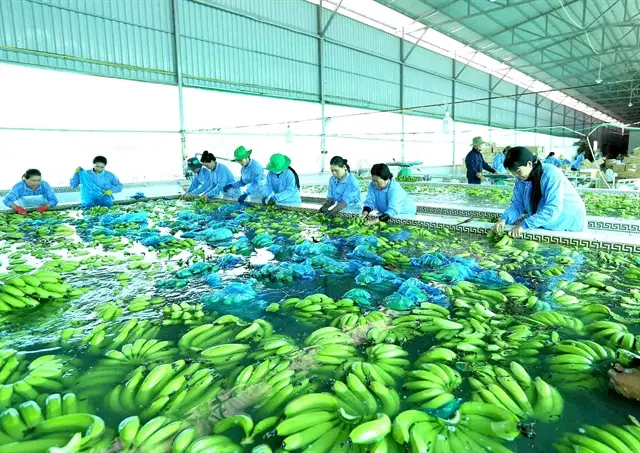
Pre-Cooling: Immediately after harvest, bananas must be washed and pre-cooled to 13°C within 6-8 hours.
Container: 40ft High Cube Reefer Container.
Temperature Setting: 13.2°C to 13.5°C.
Ventilation: 15-20 CBM (Fresh air exchange).
Volume: One 40ft container holds approx 1,540 boxes (Palletized) or 1,650+ boxes (Non-Palletized).
Transit Time: Mumbai to Jebel Ali (Dubai) = 4 to 5 Days.
6. Profitability Snapshot (Estimates)
Prices fluctuate daily. These are indicative for 2025.
Sourcing Cost (Farm Gate): ₹12 - ₹15 per Kg
Processing & Packing: ₹150 - ₹180 per Box (includes box, washing, labor)
Transport & FOB Expenses: ₹50 per Box
Total FOB Cost: Approx $4.50 - $5.50 per Box.
Selling Price (CIF Dubai): $6.50 - $8.50 per Box (depending on market).
Margin: Approx $1.00 - $1.50 per Box.
Volume Game: A single container profit can be ₹1 Lakh - ₹1.5 Lakhs.
7. Documentation Checklist
Phytosanitary Certificate: Issued by Plant Quarantine India. Prove your bananas are pest-free.
Certificate of Origin: To claim duty benefits (if any).
Commercial Invoice & Packing List.
Bill of Lading.
Quality Inspection Report: (Optional but recommended) from SGS or similar to avoid disputes.
8. Action Plan for Exporters
Don't buy from Mandi. Buy directly from contract farmers or packhouses. Mandi bananas are handled roughly and will have invisible bruises that turn black in Dubai.
Visit the Packhouse. Ensure they are using Alum water to wash latex and Fungicide (post-harvest treatment) to prevent Crown Rot.