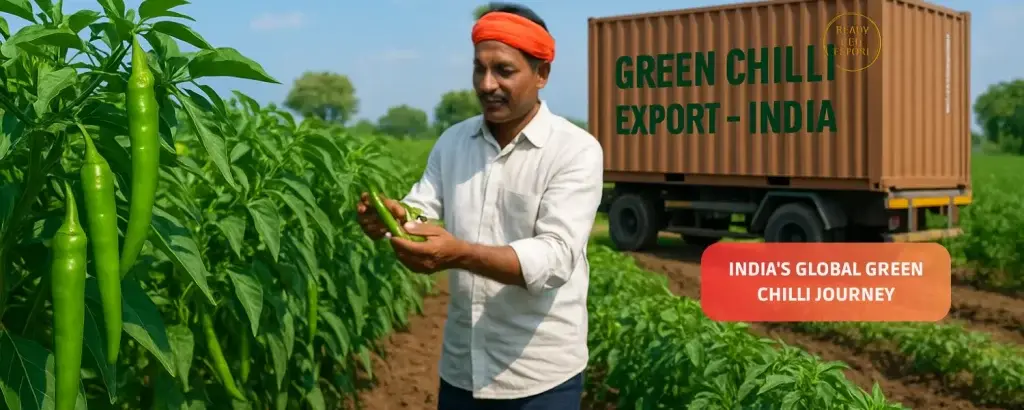
ndia is not just the land of spices; it is the world's largest producer, consumer, and exporter of chillies. For an aspiring exporter, the "Green Chilli" is a perishable commodity that offers high turnover and year-round demand. Unlike dry red chillies, fresh green chillies require precision in logistics and quality control, but the margins can be significantly higher.
This guide covers everything from variety selection to the strict EU pesticide norms, backed by the latest available market data.
1. The Market Opportunity: By the Numbers
Global Standing: India contributes nearly 35-40% of total world chilli production.
Export Volume: In FY 2023-24, India's fresh green chilli exports remained robust, with major volumes shipping to the Middle East and UK.
Top Importers:
UAE & Middle East: The biggest volume buyers. They prefer the G4 variety (dark green, 4-6 inches).
United Kingdom: A high-value market that strictly demands the Jwala (Finger) variety and has zero tolerance for pesticide residue.
Singapore & Malaysia: Consistent buyers for varied grades.
Qatar, Oman, Kuwait: Follow similar trends to the UAE.
2. Key Varieties for Export
Choosing the right variety is critical because a UAE buyer will reject what a UK buyer loves.
| Variety | Characteristics | Target Market | Key Sourcing States |
| G4 (Green 4) | Dark green, 4-6 inches, smooth skin, high pungency. Thick skin gives it a longer shelf life. | Middle East (UAE, Qatar, Oman) | Andhra Pradesh, Telangana, Maharashtra |
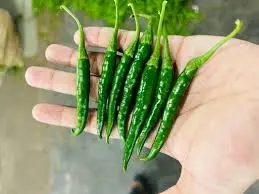
| Jwala | Light green, long, curvy, highly pungent. Known as "Finger Chilli". Shorter shelf life. | UK, Europe, USA | Gujarat, Madhya Pradesh |
| Teja (S17) | Very spicy, sharp. often exported dry, but fresh demand exists for specific cuisines. | China, SE Asia | Andhra Pradesh, Telangana |
| Bullet | Short, thick, very spicy. | Niche Markets | Karnataka, Maharashtra |
3. Production Hubs: Where to Source?
You cannot export successfully if you buy from the wrong mandi. Sourcing directly from production belts ensures freshness, which is vital for the 15-20 day sea voyage to the Gulf.
Andhra Pradesh & Telangana: The powerhouses. Guntur, Khammam, and Warangal are the main hubs.
Data Point: Andhra Pradesh alone produced over 1.1 million tonnes of chilli in recent cycles.
Maharashtra: Solapur and Nashik are key for the G4 variety. They are geographically closer to JNPT (Mumbai port), reducing inland transit time.
Gujarat: Vadodara and Surat belts are famous for the Jwala variety destined for the UK.
4. The Export Process: Step-by-Step
Step 1: Mandatory Registrations
IEC Code: Import Export Code from DGFT.
APEDA Registration (RCMC): Mandatory. You cannot export fresh veg without this.
Phytosanitary Certificate (PSC): Issued by plant quarantine officials. It certifies your shipment is pest-free.
Step 2: Sourcing (The "Traceability" Factor)
For Middle East: You can source from local Mandis (APMC) if quality is good.
For Europe/UK: You MUST source from APEDA-registered farms. The EU requires "Farm-to-Fork" traceability. You cannot just buy open market stock for Europe; it will fail residue tests.
Step 3: Quality Control & Packing
Sorting: Remove any broken, yellowing, or crooked chillies.
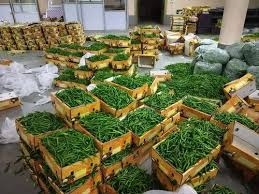
Net Weight: Standard packing is 3.8 kg to 4 kg Net Weight in a 5-ply Corrugated Box.
Ventilation: Boxes must have air holes to prevent moisture buildup (which causes rotting).
Step 4: Logistics (Air vs. Sea)
By Air (to UK/Europe):
Transit: 10-12 hours.
Cost: High (approx. ₹80-120/kg freight depending on season).
Ideal for: Jwala variety (low shelf life).
By Sea (to Dubai/Gulf):
Transit: 5-8 days to Jebel Ali.
Container: 40ft Reefer Container (Temperature controlled).
Temp Setting: 7°C to 8°C. (Too cold = chilling injury/black spots; Too hot = ripening/redness).
Cost: Low. A container carries ~14-16 tonnes.
5. The Biggest Challenge: Pesticide MRLs (EU)
The European Union has set Maximum Residue Limits (MRLs) for pesticides at near-zero levels (often 0.01 mg/kg).
The Risk: If one sample fails at the destination port, the entire container is destroyed at your cost, and you face a heavy penalty + alert notification.
Banned Chemicals: Do not use Acephate, Carbendazim, Chlorpyrifos, or Triazophos on crops meant for Europe.
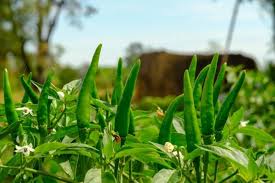
Solution: For EU exports, strictly use polyhouse-grown or residue-free certified chillies.
6. Profitability Analysis (Hypothetical Scenario)
Note: Prices fluctuate daily. This is a model for estimation.
Scenario: Exporting 1 Ton of G4 Green Chilli to UAE by Sea (Part of a shared container or LCL for calculation simplicity, though usually FCL is preferred).
| Cost Component | Estimated Cost (₹ per kg) |
| Buying Price (Mandi) | ₹25 - ₹40 |
| Sorting & Grading Labor | ₹3 - ₹5 |
| Packing Material (Box + Strap) | ₹6 - ₹8 |
| Inland Transport to Port | ₹3 - ₹5 |
| Port Handling & THC | ₹2 - ₹4 |
| Sea Freight (Reefer) | ₹5 - ₹8 |
| Total Cost (CNF Dubai) | ₹44 - ₹70 per kg |
Selling Price in Dubai: Often ranges from AED 3.5 to AED 6.0 per kg (₹80 - ₹135).
Gross Margin: Can be 20% to 50%, but high risk of spoilage claims can wipe this out.
7. Future Trends
Value Addition: Exporting Green Chilli Paste or Freeze Dried Chilli is growing as it removes the perishability risk.
Organic: High demand in Germany and France, fetching premiums of 30-40%.
Summary Checklist for Exporters
[ ] Get IEC & APEDA RCMC.
[ ] Identify market (UAE = Volume; UK = Value).
[ ] Secure payment terms (Try for 50% Advance; avoid 100% credit).
[ ] Ensure Pre-cooling to remove field heat before packing.
[ ] Book Reefer container at 7°C.