Sugarcane bagasse is the fibrous residue left after juice extraction. For decades, it was burned as low-grade fuel. Today, it is molded into heat-resistant, grease-proof, and 100% compostable tableware. India, being the world's second-largest sugarcane producer, has a massive raw material advantage, allowing exporters to offer competitive pricing to the USA, Europe, and the Middle East.
1. Market Intelligence: Global Demand in 2026
The global market for bagasse plates and containers has crossed $3.2 Billion in 2026, with a steady growth rate of over 7%.
The Big Three Importers: UAE (50%), USA (23%), and the UK (16%) collectively account for nearly 90% of India's current exports.
The EU Opportunity: Under the Packaging and Packaging Waste Regulation (PPWR) taking full effect in August 2026, any food service business in the EU must offer plastic-free alternatives, creating a massive vacuum for Indian bagasse exporters.
Key Trend: Demand is shifting from simple plates to "Leak-Proof Clamshells" and "Microwave-Safe Meal Trays" for cloud kitchens and food delivery apps.
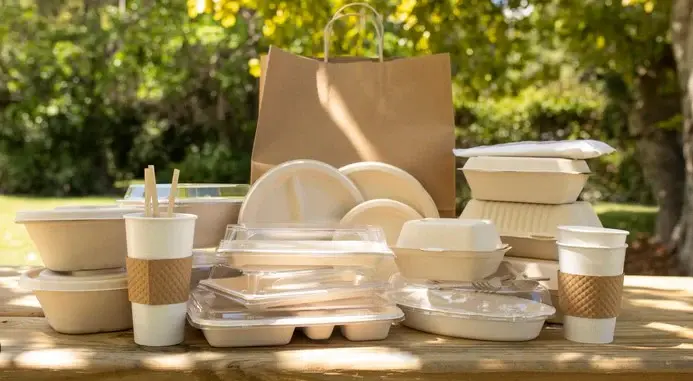
2. The Product: Technical Superiority
Why are buyers choosing Indian bagasse over paper or bamboo?
Heat & Cold Resistance: Can withstand temperatures from -25°C to 200°C. It is freezer-safe and microwave-safe.
Structural Integrity: Unlike paper, it doesn't get soggy. It is naturally resistant to grease and oil for up to 24 hours.
Sustainability: It is "Backyard Compostable," meaning it breaks down in 60-90 days in a home compost bin, unlike PLA (cornstarch) which requires industrial facilities.
3. Classification & HS Codes
Using the correct HS code is critical for claiming export incentives like RoDTEP.
| Product Category | HS Code | Description |
| Molded Bagasse Articles | 4823 70 10 | Trays, clamshells, and bowls made from molded pulp. |
| Bagasse Plates/Cups | 4823 69 00 | Plates and other tableware (other than bamboo). |
| Cutlery (Bagasse-based) | 4419 90 90 | Often classified under wooden/tableware articles. |
4. Mandatory Compliance & "Green" Certifications
In 2026, "Greenwashing" is heavily penalized. Your product must carry third-party certifications to enter premium markets.
North America: ASTM D6400 and BPI Certification. These are mandatory for most US retailers.
Europe: EN 13432 (TÜV Austria / OK Compost). Without this, your goods cannot be labeled as "Compostable" in the EU.
The PFAS Ban (2026): Many US states and EU countries have banned PFAS (forever chemicals) used for oil resistance. Ensure your manufacturer uses PFAS-Free coatings.
EPR Registration: For the EU (especially Germany's LUCID and France's Triman), you must register under Extended Producer Responsibility schemes to track the waste your packaging generates.
5. Top Indian Manufacturers & Sourcing Hubs
Most production is clustered near sugar mills in Uttar Pradesh, Gujarat, and Maharashtra.
| Manufacturer | Location | Specialty |
| Pakka Limited (CHUK) | Ayodhya, UP | Market leader; 100% backyard compostable designs. |
| Growood India | Ahmedabad, GJ | High-volume export of round plates and meal trays. |
| Grabeco Packaging (GoEco) | Neemrana, RJ | State-of-the-art leak-proof clamshell production. |
| Ecolates | New Delhi | Focus on luxury HoReCa (Hotel/Restaurant) designs. |
| Greenvale Eco Products | Ichalkaranji, MH | 100% chemical-free organic pulp processing. |
6. Logistics: Packing for the Voyage
Bagasse is lightweight but takes up significant volume.
Packing: Standard export packing involves Shrink-Wrapping packs of 25 or 50 pieces to prevent moisture absorption during the sea voyage.
Palletization: Always use Fumigated Pallets (ISPM-15 standard).
Container Load: A 40ft High Cube (HC) container can hold approx 600 to 800 cartons, depending on whether it is clamshells (bulky) or plates (nestable).
7. Action Plan for Exporters
Select Your Niche: Don't just sell plates. Target "Hinged Clamshells" for the takeaway industry where margins are 15% higher.
Verify the Factory: Visit the unit to ensure they use a Hydraulic Hot Press process. This ensures the edges are smooth and the product doesn't "flake" during use.
Lab Reports: Request a "Food Contact Safety" report from an NABL-accredited lab to prove zero chemical migration into hot food.
Summary Checklist for 2026
[ ] Register with APEDA for RCMC and incentives.
[ ] Ensure PFAS-Free manufacturing.
[ ] Obtain ASTM D6400 (USA) or EN 13432 (EU) certificates.
[ ] Set up EPR Registration for the target country.
[ ] Secure 30% Advance + 70% LC/BL payment terms.